If you’ve ever walked through a manufacturing facility, debugged a 3D printed part at a prototyping lab, or even used a paint sprayer to refresh a piece of furniture, odds are you’ve interacted with a screw air compressor. For years, these workhorses were bulky, power-hungry, and limited to large industrial spaces—but compact screw air compressors have redefined their use over the last decade. As a compact screw air compressor supplier who’s worked with hundreds of small and mid-sized operations, I get asked all the time: which should you choose, oil-injected or oil-free? It’s not a one-size-fits-all answer, and that’s because each type’s design makes them perfect for very specific scenarios. Compact Screw Air Compressor
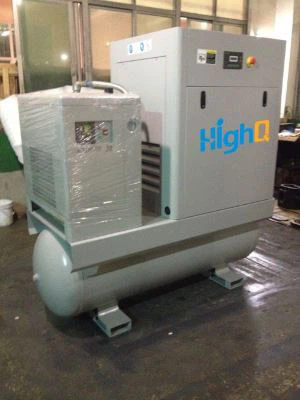
Let’s start with the basics: oil-injected compact screw air compressors work by injecting a small amount of lubricating oil into the compression chamber. This oil cools the rotating screws, seals tiny gaps between them to prevent air leakage, and reduces wear on the parts. The end product is compressed air that has trace amounts of oil—usually 2 to 5 parts per million (ppm), depending on the unit. Oil-free compact screw air compressors, on the other hand, eliminate oil entirely from the compression process. They use specialized coatings, tight precision machining, and separate cooling systems to keep the screws moving without lubrication, so their compressed air is virtually 100% oil-free, with only incidental contamination from the environment.
Now, let’s dive into the scenarios where each excels, because that’s where most buyers get stuck. Oil-injected compressors are the workhorses for tasks that don’t need super-clean air, but demand efficiency, low cost, and durability. Let’s take small-scale metal fabrication shops, for example. I worked with a custom metal fab in Ohio last year that was using a 100-gallon reciprocating compressor that kept breaking down on their cutting and bending tools. They switched to a 7.5 HP oil-injected compact screw compressor that fit on a 2×3 ft shelf in their back shop, and it cut their maintenance costs by 40% in the first six months. Their tools—plasma cutters, pneumatic benders, spray guns for metal primer—all don’t require air free of oil; a little trace oil actually helps keep the tools’ seals lubricated, so they last longer. Another scenario: automotive repair garages, especially small independent shops. These garages use air for impact wrenches, tire changers, and paint sprayers that only need a light coat of primer, not clear coat. Oil-injected compact screw compressors are lightweight, easy to move between bays, and way more energy-efficient than reciprocating units for daily, continuous use. One shop owner told me he used to pay $800 a month on electricity for his old compressor; the compact screw unit cut that to $450, and he didn’t have to drain water or change oil as often.
Then there’s packaging and general assembly lines. Most consumer goods—shampoo bottles, cereal boxes, electronics—use pneumatic tools to seal packages, attach labels, and move parts down the line. These applications don’t need ultra-clean air, so oil-injected units are ideal. A snack packaging plant in Texas we supplied had a problem with their old large compressor being too loud and taking up floor space, so they swapped in four 5 HP compact oil-injected units that fit in unused corners of their production floor. The trace oil in their air didn’t contaminate the food packaging, because the final food-contact materials are sealed with a plastic layer that doesn’t let any air touch the product. That’s a key point: oil-injected compressors work great for packaging as long as the air doesn’t come into direct contact with food or pharmaceuticals. Construction subcontractors also love oil-injected compact units. Framers, roofers, and drywallers need portable, powerful air to run nail guns, staplers, and sanders. Compact oil-injected compressors are lighter than full-size industrial units, easy to load into a work truck, and can run for hours without overheating. I’ve had contractors tell me they’d rather have a compact screw unit than a reciprocating one because it’s quieter—no more waking up neighbors when they start work early on a residential job.
Now, oil-free compact screw air compressors aren’t just for “clean” applications—they’re for applications where even trace oil would cause costly damage or safety issues. The biggest scenario here is food and beverage processing. Think a craft brewery that fills cans with beer, a pasta maker that extrudes dough, or a nut processing plant that packages roasted nuts. These operations require compressed air that’s food-grade, meaning it can’t have any oil, because the air often comes into direct contact with the product. Last year, we supplied a 10 HP oil-free compact screw compressor to a craft brewery in Colorado. They used to rent a large oil-free unit for their canning season, which cost them $2,000 a month, and it was too big to fit in their small production space. The compact unit we provided fit next to their brewing tanks, and it produces air with less than 0.1 ppm of oil, perfect for filling cans without leaving a greasy residue that would ruin the beer’s taste. Another key scenario is pharmaceutical and medical device manufacturing. These industries have strict regulations—from the FDA in the U.S. to the EU’s GMP (Good Manufacturing Practices) guidelines—that require air to be completely free of oil and contaminants. Medical device makers use compressed air to assemble pacemakers, syringes, and surgical tools. If even a tiny drop of oil got into the assembly line, it could contaminate a product that goes into a patient, leading to recalls or serious health risks. Oil-free compact screw compressors are designed with extra filtration systems to remove any moisture or particulate, so they meet those strict standards.
3D printing and prototyping labs are another growing scenario for oil-free compact units. Many small-scale 3D print shops and university maker spaces use compressed air to run their CNC routers, filament extruders, and sanding tools for finished parts. Oil in the air can get into the 3D printer’s hot end or extruder, ruining expensive filament or leaving a greasy finish on a prototype. A maker space in Chicago we worked with had a 3D printer that kept failing because oil from their old compressor was coating the nozzle. Swapping to an oil-free compact screw compressor fixed the problem, and they’ve since added it to run their CNC machines too, which also need clean air to cut acrylic and metal without contamination. Electronics manufacturing is similar. Companies that make smartphones, laptops, and circuit boards use compressed air to clean off dust from tiny components, run pick-and-place machines, and test pressure seals on devices. Even a small amount of oil can damage sensitive electronics, causing short circuits or malfunctions. Oil-free compact units deliver consistent, clean air that doesn’t leave residue on delicate parts, making them a staple in small electronics assembly lines and repair shops.
There are a few other scenarios that people often overlook, too. Environmental testing labs, for example, use compressed air to run air samplers that measure pollutants in the atmosphere. If the air had oil, it would skew test results, making it look like there are more pollutants than there actually are. Oil-free compact units are portable, so they can be set up in remote locations for field testing, which is perfect for small environmental firms that don’t need a large industrial system. Also, luxury woodworking shops—those that make high-end furniture or musical instruments like guitars or violins—use compressed air to spray finishes, sand wood, and run tools. Oil in the air can leave a greasy film on wood, which ruins the finish and requires extra sanding work. Oil-free compact compressors deliver clean air that gives a smooth, even finish, which is critical for premium wood products.
Now, let’s talk about what to watch out for when choosing between the two, because it’s not just about the application. Oil-injected compressors are more energy-efficient than oil-free ones for the same CFM (cubic feet per minute) output, because they don’t need the extra seals and cooling systems that oil-free units require. They’re also less expensive upfront, which is a big plus for small businesses on a budget. But they do require more maintenance: you have to change the oil every 500 to 1,000 hours, replace air and oil filters regularly, and have a good filtration system downstream to remove any oil from the air before it touches tools or products. Oil-free units, on the other hand, have longer lifespans in clean applications because there’s no oil to break down or contaminate the system, but they use about 10-15% more energy than oil-injected units, so they’re more expensive to run over time. They also need regular inspections of their screw coatings, since wear can lead to tiny gaps that let oil into the air over time.
As a compact screw air compressor supplier, I’ve seen too many buyers make the mistake of buying the wrong type for their needs. A few years ago, a small bakery in Kansas bought an oil-free compact compressor because they thought it would be cleaner, but they ended up paying twice as much in electricity costs, and they didn’t even need it—their air only ran the oven’s control panel, which didn’t require food-grade air. They could have saved thousands by going with an oil-injected unit. On the flip side, a auto body shop in Arizona tried to use an oil-injected compressor for their clear coat spray booth, and they ended up ruining $5,000 worth of car paint because of oil residue. That’s the kind of mistake we help people avoid every day.
At the end of the day, the right choice comes down to two questions: Do I need compressed air that comes into direct contact with food, pharmaceuticals, electronics, or sensitive prototypes? And can I afford a small amount of trace oil, in exchange for lower upfront and operating costs? For most small to mid-sized businesses, oil-injected compact screw compressors will cover 80% of their needs, from construction to general manufacturing to packaging. Oil-free units are the right pick for the other 20%, when clean air is non-negotiable.
If you’re not sure which type is right for your operation, I’d be happy to walk through your specific needs—whether you’re a small shop, a lab, or a production line. We work with businesses of all sizes, and we don’t believe in one-size-fits-all solutions. Reach out to us to discuss your air compression needs, and we’ll help you find the compact screw air compressor that fits your budget and your application.
Water-Lubricated Oil-free Screw Air Compressor References
- Compressed Air Best Practices. (2022). "Oil-Injected vs. Oil-Free Compressors: Application Guidelines for Small and Medium Enterprises." Compressed Air Best Practices Magazine, Vol. 18, No. 3, pp. 45–52.
- Occupational Safety and Health Administration (OSHA). (2021). "Compressed Air Safety Standards for Portable Tools." U.S. Department of Labor, OSHA Technical Manual, Section 5, Chapter 1.
- International Organization for Standardization (ISO). (2019). "ISO 8573-1: Compressed Air-Part 1: Contaminant Purity Classes." International Organization for Standardization, Geneva.
- Food and Drug Administration (FDA). (2020). "Guidance for Industry: Compressed Air in Food and Beverage Processing." U.S. Food and Drug Administration, Center for Food Safety and Applied Nutrition.
- National Association of Manufacturers (NAM). (2023). "Energy Efficiency in Compact Compressed Air Systems." NAM Small Manufacturers Report, Vol. 12, No. 2, pp. 11–18.
Xiamen HighQ Compressor Co., Ltd.
With over 20 years’ experience, Xiamen HighQ Compressor Co., Ltd. is one of the most professional compact screw air compressor manufacturers and suppliers in China. We warmly welcome you to buy high quality compact screw air compressor made in China from our factory. Good service and punctual delivery are available.
Address: 7th F. No.704 Yi Hua Center Xiamen China 361100
E-mail: vincent@hqcompressor.com
WebSite: https://www.hqcompressor.com/
